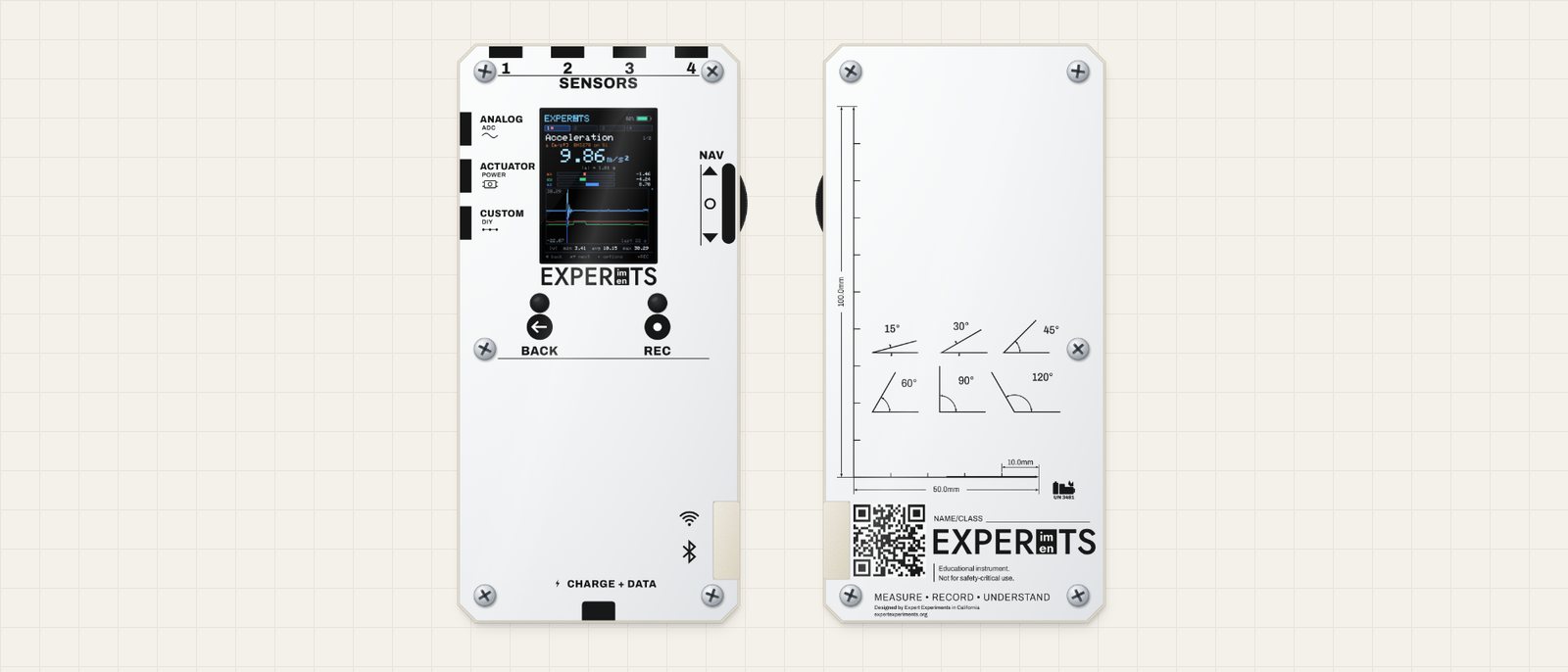
Meet the Hepek
Three short stations: a sensor that lags, a sensor you calibrate and a signal hiding in noise.
Scientists never take a new instrument on trust. Test three Hepek sensors the way they would: how fast each responds, how accurate it is and how small a change it can detect.
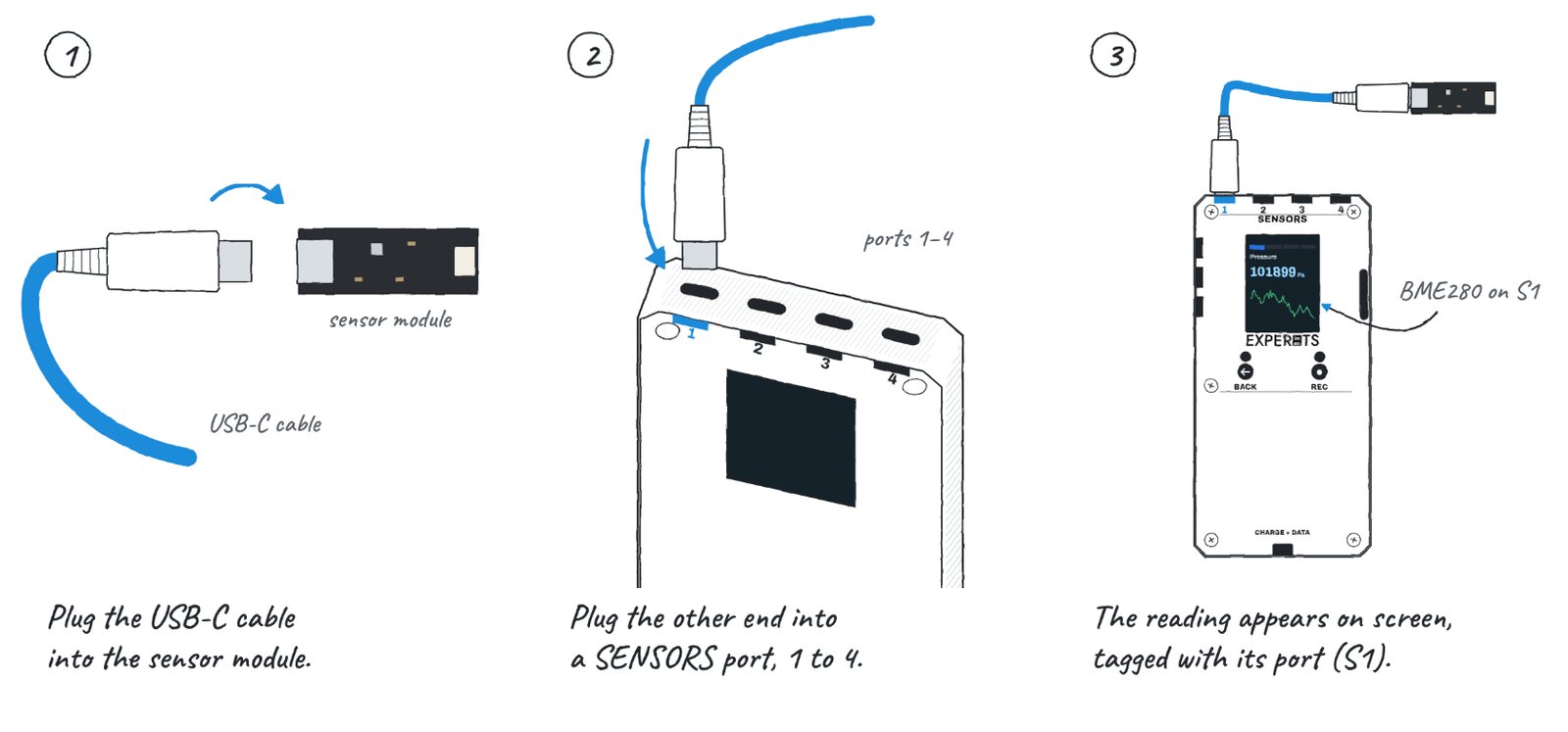
Plug pods into any port and connect the Hepek by USB (Chrome or Edge on a computer) or Wi-Fi. No Hepek? Upload the sample recordings instead: breath test, up and down.
Predict
You breathe once onto a humidity sensor. How soon does its reading peak?
Air pressure falls as you go up. How much lower is it 2 m above the floor? Guess.
Station 1 · How fast does a sensor respond?
Weather pod. Your breath is warm and humid. Watch how the readings follow it.


On the humidity graph, drag from the start of the rise to the peak. How long did the sensor take?
Your breath lasted about a second. Why does the reading take longer to rise, and much longer to fall?
Station 2 · Is the sensor right?
Distance pod. A tape measure is your standard. Check the sensor against it.
A perfect sensor lies on the line \(d = \text{tape}\). The fit \(d = k\,\text{tape} + n\) shows how yours differs: \(k \ne 1\) is a scale error, \(n \ne 0\) an offset.
A sensor's calibration fit is \(d = 1.02\,\text{tape} + 0.015\ \mathrm{m}\). It reads 0.525 m. What is the true distance?
Is your sensor's error larger at short or long distances? What could cause that?
Station 3 · Can you find a signal in the noise?
Weather pod. Pressure falls as you go up, because less air is pressing down from above. Over a person's height the change is tiny. Can the sensor see it?
Air has density \(\rho = 1.2\ \mathrm{kg/m^3}\), and the pressure difference across a height \(h\) is \(\Delta p = \rho g h\). What is it for \(h = 2.0\ \mathrm{m}\)?
Drag across the floor part, then the overhead part, and compare their means. What pressure difference did you measure?
Is your difference clearly bigger than the wobble in the flat parts? Would the sensor notice a 20 cm change?
Habit to keep: test an instrument against something you know before you trust it: a standard, a theory, or simply leaving it alone.